The Digital Achilles Heel: Why Ransomware Has Become Maritime's Costliest Operational Threat
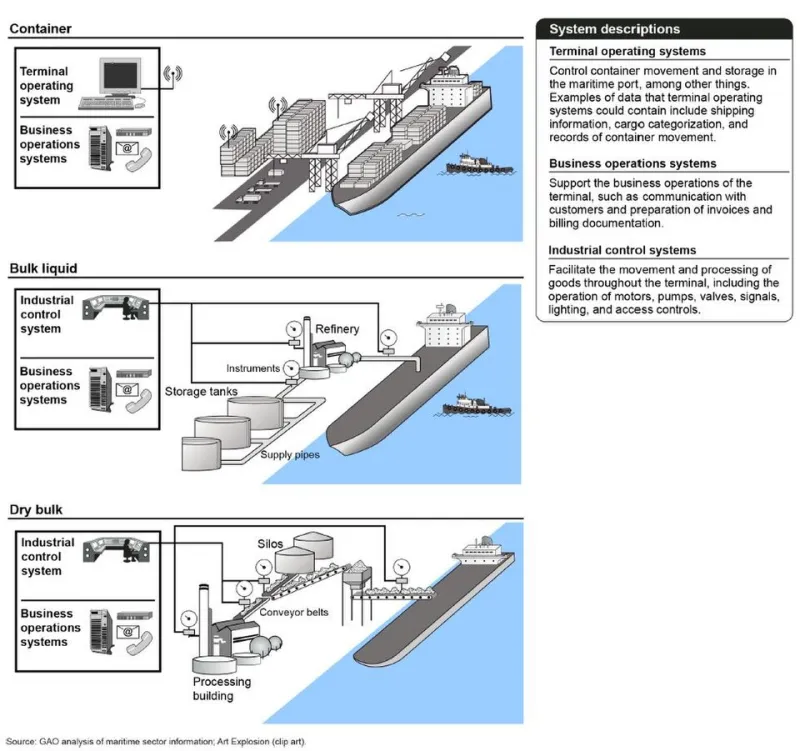
Photo: U.S. Government Accountability Office from Washington, DC, United States, Public domain, via Wikimedia Commons
For decades, the maritime industry measured operational risk in familiar units: weather windows, fuel costs, labor disputes, and port congestion. Those risks remain. But a new category of threat has inserted itself into the calculus with startling speed—one that requires no vessel, no dock access, and no physical presence whatsoever. Ransomware and coordinated cyberattacks have quietly become among the most financially damaging hazards facing American port operators and carriers today.
The shift has not happened in isolation. It is the direct consequence of an industry that has digitized aggressively and, in many cases, secured those systems inadequately. Every terminal management platform, every electronic bill of lading, every AIS integration, and every port community system now represents a potential entry point. And unlike a storm that approaches on radar, a cyberattack arrives without warning.
From Theoretical Risk to Operational Reality
The maritime sector spent years treating cybersecurity as a compliance checkbox rather than an operational imperative. That posture has proven costly. The 2017 NotPetya attack on Maersk—widely cited as the most destructive cyberattack in commercial history—resulted in an estimated $300 million in losses and temporarily paralyzed 17 of the company's container terminals worldwide. Operations at the Port of Los Angeles were disrupted. Vessels sat idle. Documentation chains collapsed.
More recently, the Port of Lisbon and the Port of Houston have both reported intrusion attempts targeting operational technology systems. In 2021, a ransomware group breached the systems of Oiltanking GmbH in Germany, disrupting fuel distribution across a network that included maritime supply chains. Each incident followed a recognizable pattern: an under-monitored system, a delayed detection response, and a remediation cost that dwarfed what a preventive security investment would have required.
For US operators, the threat landscape is not abstract. The Coast Guard has issued multiple maritime cybersecurity alerts in recent years, and the Transportation Security Administration has expanded its cybersecurity directives to encompass port facility operators. Regulatory pressure is building. But regulation tends to follow incidents rather than prevent them.
Where the Vulnerabilities Actually Live
Understanding the attack surface in maritime operations requires looking beyond the obvious. Most operators have reasonable perimeter defenses on their administrative IT systems. The more dangerous exposure typically exists in operational technology—the software and hardware that controls physical processes like crane automation, vessel traffic management, fuel loading systems, and gate access.
These systems were often designed and installed years before cybersecurity was a meaningful design criterion. Many run on legacy operating systems that no longer receive security patches. They are frequently networked with administrative systems for operational convenience, creating a bridge that attackers can use to move laterally from a phishing email in accounts payable to a terminal management system controlling cargo throughput.
Cargo documentation systems present a separate but equally serious vulnerability. Electronic bills of lading, customs filing platforms, and freight management software are increasingly cloud-hosted and accessed by multiple parties across the supply chain—freight forwarders, customs brokers, trucking companies, and terminal operators. Each additional access point is a potential weakness. A compromised credential at a mid-sized freight broker can, in the wrong architecture, provide a pathway into a port's core documentation infrastructure.
Vessels themselves are not immune. Modern ships carry integrated bridge systems, electronic chart displays, and cargo management software that are increasingly internet-connected for remote diagnostics and real-time data transmission. The attack surface has moved offshore.
The Financial Arithmetic of a Breach
Operators who have not yet quantified the financial exposure of a serious cyberattack tend to underestimate it significantly. The visible costs—ransom payments, IT remediation, system restoration—are only the beginning. The more damaging costs are operational: vessels unable to berth because terminal systems are offline, cargo held at the gate because documentation cannot be verified, perishable freight destroyed because temperature-controlled handling systems are inaccessible.
For a mid-sized US container terminal processing several thousand TEUs per day, even a 48-hour operational shutdown can translate into millions of dollars in direct losses, demurrage claims from carriers, and reputational damage that reshapes shipper relationships for years. Cyber insurance has become more widely adopted, but insurers have grown increasingly restrictive about coverage terms, and premiums have risen sharply as the claims environment has deteriorated.
The indirect costs extend further. Regulatory investigations, mandatory incident reporting under Coast Guard protocols, and potential civil liability from cargo owners whose shipments were damaged or delayed all compound the initial financial impact. For publicly traded operators, the market response to a disclosed breach adds another layer of exposure.
What Forward-Thinking Operators Are Doing Differently
The maritime operators who have made meaningful progress on cybersecurity share several common practices. First, they have moved away from treating IT and operational technology as separate security domains. Unified security operations that monitor both environments—with clearly defined protocols for isolating operational systems during an active incident—have proven far more resilient than siloed approaches.
Network segmentation is a foundational control that many operators have implemented only partially. Properly segmenting terminal management systems, vessel traffic systems, and administrative networks so that a breach in one domain cannot propagate freely into others is technically straightforward but requires disciplined implementation and ongoing maintenance.
Vendor and third-party access management has emerged as a critical control point. Many successful intrusions have entered through remote access credentials belonging to equipment vendors, software providers, or maintenance contractors. Implementing multi-factor authentication, time-limited access windows, and continuous monitoring of third-party sessions has closed a significant share of historical attack vectors.
Tabletop exercises—structured simulations of a cyberattack scenario involving operations leadership, IT teams, and communications staff—have helped operators identify response gaps before a real incident forces the issue. The operators who have conducted these exercises consistently report that their initial confidence in their incident response capabilities was misplaced, and that the exercise surfaced critical coordination failures that would have been catastrophic under actual attack conditions.
Finally, information sharing through sector-specific channels has gained traction. The Maritime Information Sharing and Analysis Center, along with Coast Guard partnerships, provides operators with threat intelligence that individual organizations could not generate independently. Participation in these networks has become a meaningful differentiator between operators who are aware of emerging threat patterns and those who are not.
The Regulatory Horizon
Federal regulators have signaled clearly that voluntary compliance frameworks will not remain the standard indefinitely. The Coast Guard's 2020 Maritime Cybersecurity Standards rulemaking process, combined with TSA's expanded directives and the broader push from the Cybersecurity and Infrastructure Security Agency, suggests that mandatory minimum standards for port facility operators are approaching. Operators who have invested proactively will face less disruption from that transition. Those who have deferred will find themselves managing compliance pressure and operational vulnerability simultaneously.
The digitization of maritime commerce is irreversible, and its benefits—operational efficiency, cargo visibility, documentation speed—are real. But every system that connects to a network introduces risk that must be actively managed. The industry has spent the last decade building digital infrastructure. The next decade will be defined, in part, by how well that infrastructure is defended.