Unequal Waters: How Fragmented State Licensing Standards Are Splitting American Ports Into Two Classes
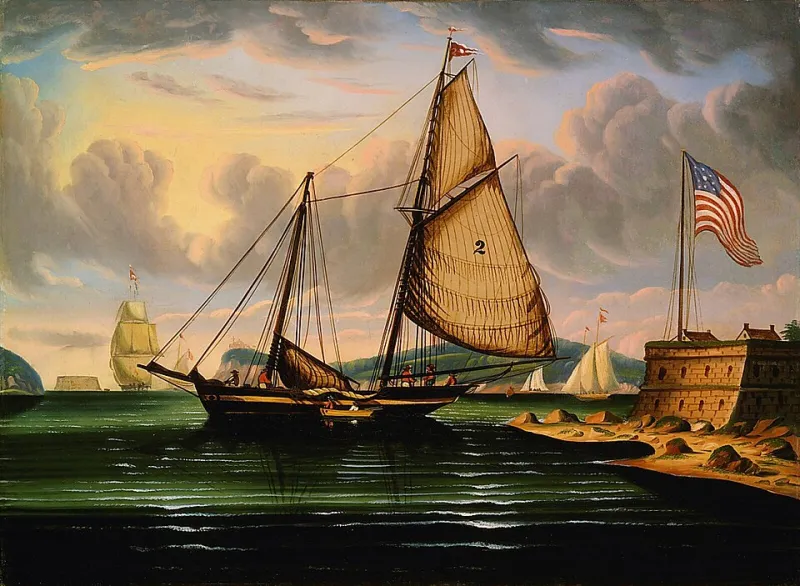
Photo: Thomas Chambers, Public domain, via Wikimedia Commons
When a bulk carrier rounds Cape Hatteras bound for the Port of Wilmington, its operators are not simply navigating a stretch of Atlantic coastline. They are entering a regulatory jurisdiction with its own pilot licensing framework, its own examination standards, and its own apprenticeship requirements—requirements that may differ substantially from those governing the next port of call three days south. Multiply that reality across dozens of active US commercial ports, and the cumulative effect on carrier scheduling, turnaround time, and operating cost becomes impossible to ignore.
Harbor pilotage in the United States is, by constitutional tradition and longstanding federal precedent, a matter of state authority. The Wilson v. Black Bird Creek Marsh Co. ruling of 1829 and the subsequent Cooley Doctrine effectively handed individual states the power to regulate compulsory pilotage within their waters. Nearly two centuries later, that jurisdictional structure remains largely intact—and the operational consequences for modern maritime commerce are growing more pronounced with each passing year.
A Licensing Landscape Built for a Different Era
No two states administer harbor pilot qualification identically. Some require candidates to complete multi-year apprenticeships aboard vessels transiting their specific waterways before sitting for a state board examination. Others accept credentials earned in adjacent jurisdictions, provided applicants pass a supplemental local knowledge assessment. A handful of states have modernized their frameworks to incorporate simulator-based training and structured competency evaluations aligned with international standards. Many have not.
The result is a credentialing ecosystem in which a pilot licensed in one state cannot automatically practice in the next, even when the physical waterways share similar characteristics. For carriers operating along the Gulf Coast or the Mid-Atlantic corridor, this means maintaining separate working relationships with distinct pilot associations at each port—associations that may differ in size, scheduling availability, and responsiveness to vessel arrival windows.
The American Pilots' Association, the national body representing state-licensed harbor pilots, has acknowledged the inconsistency but has historically defended state autonomy as a feature rather than a flaw, arguing that local expertise is precisely what compulsory pilotage is designed to ensure. That argument has merit in principle. In practice, it does not fully account for the operational friction created when workforce pipelines in certain states fall critically short.
Where the Gaps Are Widest
The ports experiencing the sharpest delays tied to pilot availability are not, in most cases, the largest container terminals on the eastern seaboard. Major hubs like the Port of New York and New Jersey and the Port of Savannah have the volume justification and the political visibility to maintain adequately staffed pilot associations, even amid a broader maritime workforce contraction.
The pressure is most acute at mid-tier and regional ports—facilities in states where pilot training pipelines have gone underfunded, where apprenticeship programs struggle to attract candidates, and where state maritime academies lack the resources to produce graduates in sufficient numbers. In these environments, a single pilot's unexpected unavailability can delay a vessel's inbound transit by hours, cascading into berth scheduling conflicts, chassis repositioning problems, and, ultimately, detention charges that land on the shipper's balance sheet.
A 2022 analysis by the National Pilot Association cited workforce attrition as a systemic concern, noting that a significant percentage of active harbor pilots across the country were within ten years of retirement age. Without accelerated recruitment and training investment, the gap between high-capacity and low-capacity pilot associations will widen—and with it, the operational divergence between well-served and underserved ports.
The Carrier Adaptation Problem
For carriers managing multi-port US itineraries, the inconsistency forces a level of port-by-port strategic customization that adds both administrative overhead and scheduling risk. Fleet deployment decisions that might otherwise be driven purely by cargo volume, berth availability, and fuel economics must now account for pilot lead times and association responsiveness at each individual stop.
Some larger carriers have begun building additional scheduling buffers into port calls at known bottleneck locations—effectively pricing the pilot availability risk into their voyage planning. Others have adjusted vessel sequencing to prioritize ports with more reliable pilot dispatch, consolidating cargo where possible to reduce the number of calls at constrained facilities. Both strategies represent rational responses to an irrational regulatory landscape, but neither eliminates the underlying inefficiency.
For mid-sized operators without the fleet depth to absorb schedule adjustments, the calculus is more difficult. A delayed pilot assignment at a secondary Gulf Coast port does not simply inconvenience a single voyage—it compresses the entire subsequent itinerary, potentially triggering late arrival penalties at the next port of call and straining relationships with cargo interests who have their own downstream commitments to honor.
The Economic Arithmetic of Regulatory Fragmentation
Quantifying the aggregate cost of pilot-related delays across the US port system is methodologically challenging, largely because the data is fragmented across state maritime boards, pilot associations, and individual carrier incident reports. What is available suggests the number is not trivial.
Port dwell time studies conducted at several mid-Atlantic and Gulf facilities have identified pilot dispatch delays as a contributing factor in a meaningful percentage of vessel arrivals that exceed scheduled berth windows. When those overruns translate into demurrage exposure, the financial impact on shippers can range from thousands to tens of thousands of dollars per incident—costs that, over the course of a full shipping season, accumulate into a material drag on supply chain economics.
Beyond direct delay costs, there is a subtler competitive distortion at work. Ports in states with well-resourced, efficiently managed pilot associations gain a quiet structural advantage over peers where the licensing pipeline is thin. Carriers notice. Over time, cargo gravitates toward reliability, and ports with chronic pilot availability problems risk losing volume to competitors that can offer more predictable vessel handling—regardless of other infrastructure advantages they may hold.
Paths Toward a More Coherent System
Federal intervention in state pilotage regulation faces significant constitutional and political headwinds. However, there are collaborative mechanisms short of federal preemption that could meaningfully reduce the operational fragmentation carriers currently absorb.
Regional compacts among neighboring state maritime boards—allowing for mutual recognition of pilot credentials under agreed competency standards—would reduce the credentialing barriers that prevent experienced pilots from filling short-term capacity gaps across state lines. Several Gulf Coast states have explored limited versions of this arrangement, and the early results suggest that mutual recognition, properly structured, need not compromise local knowledge requirements.
Federal investment in state maritime academy infrastructure, channeled through programs administered by the Maritime Administration, could accelerate the pipeline of qualified pilot candidates in states where training capacity has lagged. This approach preserves state authority while addressing the workforce deficit that underlies many of the most acute bottlenecks.
For carriers and shippers, the near-term imperative is one of transparency. Understanding which ports carry pilot availability risk—and building that knowledge systematically into voyage planning and contract negotiations—is the most immediately actionable response to a regulatory environment that is unlikely to change quickly.
The Competitive Stakes
America's port infrastructure is under sustained pressure from reshoring-driven volume growth, evolving trade lane dynamics, and accelerating vessel size increases that demand ever-more-precise coordination between ships and shore. Against that backdrop, a harbor pilot system defined by state-level inconsistency is not merely an administrative inconvenience—it is a structural vulnerability in the national supply chain.
The ports that emerge as preferred calls in the next decade will be those that can offer carriers the full package: adequate berth capacity, efficient cargo handling, and reliable, professionally staffed pilot services. States that invest in closing their training and licensing gaps now will be positioned to compete for that business. Those that do not may find that the two-tier system currently taking shape becomes permanent.