Ports Under Pressure: How the Reshoring Wave Is Testing the Limits of US Maritime Infrastructure
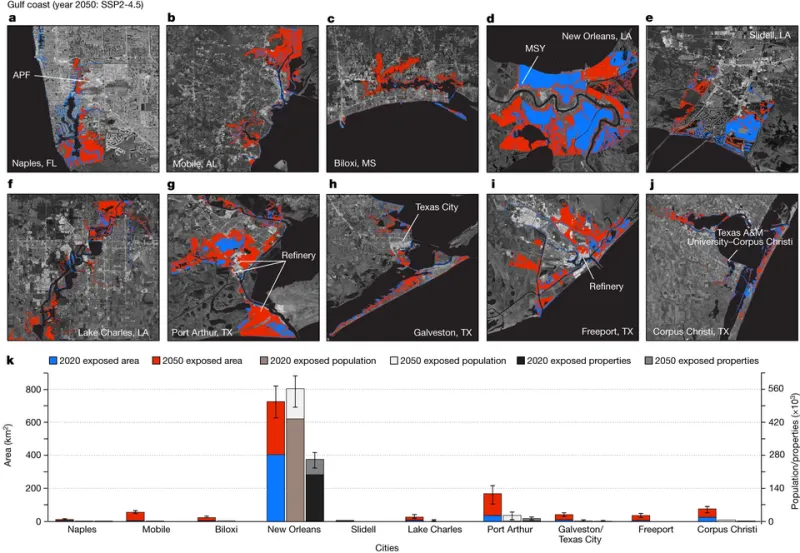
Photo: Authors of the study: Leonard O. Ohenhen, Manoochehr Shirzaei, Chandrakanta Ojha, Sonam F. Sherpa & Robert J. Nicholls, CC BY 4.0, via Wikimedia Commons
For decades, the prevailing logic of American manufacturing held that production should follow the lowest-cost labor market, regardless of geography. That logic is now being systematically dismantled. Escalating tariffs, pandemic-era supply chain failures, and a broader reassessment of strategic dependency on foreign production have collectively ignited a reshoring boom that is quietly—but fundamentally—remaking the landscape of US maritime commerce.
The implications for port operators, logistics planners, and infrastructure investors are substantial. As manufacturers accelerate domestic production, they are generating new categories of demand at US ports: heavier volumes of raw material imports, reconfigured distribution patterns for finished goods, and a growing need for inland waterway connectivity that the current system was never designed to handle at this scale.
The Tariff Effect: More Than a Policy Shift
The tariff regimes introduced over the past several years—and expanded or modified under successive administrations—have fundamentally altered the cost calculus for offshore production. For many US manufacturers, the arithmetic no longer favors distant sourcing. Steel, semiconductors, pharmaceuticals, and critical minerals have all become subjects of active reshoring strategies, each with distinct implications for where raw materials arrive and where finished products depart.
This is not a uniform phenomenon. The industries driving reshoring are geographically concentrated, and their supply chain footprints reflect that concentration. Automotive and advanced manufacturing clusters in the Midwest and South are generating demand for Gulf Coast and Great Lakes port capacity. Semiconductor fabrication facilities under construction in Arizona and Ohio require specialized import channels for industrial equipment and chemical precursors. Each of these demand streams is landing on port infrastructure that, in many cases, was last comprehensively upgraded during a different era of global trade.
Gulf Coast Positioning: Opportunity and Constraint
No region has attracted more attention in the reshoring conversation than the Gulf Coast. The Port of Houston, Port of New Orleans, and the broader network of Louisiana and Texas facilities occupy a strategically enviable position: direct access to major petrochemical and manufacturing corridors, connectivity to the Mississippi River system, and proximity to emerging nearshore manufacturing hubs in northern Mexico.
Houston's continued investment in liquid bulk and project cargo infrastructure positions it well to serve the energy transition supply chain, including the heavy equipment and specialized materials required for LNG facilities and refinery modernization. New Orleans, meanwhile, has renewed focus on its role as a gateway for agricultural exports moving down the Mississippi—a function that becomes more economically significant as domestic grain and commodity production ramps up in response to global food security pressures.
Yet the Gulf Coast's advantages are shadowed by a persistent infrastructure deficit. The Mississippi River system, which moves roughly 60 percent of US grain exports and substantial volumes of industrial commodities, is operating on lock-and-dam infrastructure that dates, in significant portions, to the mid-twentieth century. The Army Corps of Engineers has identified critical investment needs along the river, but funding timelines remain uncertain. For shippers increasingly dependent on this corridor, the gap between current capacity and projected demand represents a genuine operational risk.
Inland Waterways: The Overlooked Bottleneck
The inland waterway network—comprising the Mississippi, Ohio, Tennessee, and Illinois river systems, among others—is one of the most cost-efficient freight transportation assets in the world. Barge transport moves cargo at a fraction of the cost of truck or rail on a per-ton-mile basis, and the network's environmental footprint compares favorably with overland alternatives.
Despite these advantages, the inland waterway system has received insufficient capital investment relative to its strategic importance. Lock outages, shallow drafts during drought conditions, and aging terminal infrastructure at river ports create recurring disruptions that compound over time. As reshoring increases the volume of domestic freight moving through these corridors, the consequences of deferred maintenance become harder to absorb.
Several regional ports are positioning themselves to capitalize on this dynamic. The Port of Memphis has invested in expanded intermodal capabilities, recognizing its role as a critical junction between river, rail, and truck freight. The Port of Huntington Tri-State, serving the Ohio Valley's industrial base, has pursued infrastructure upgrades aimed at capturing a larger share of the manufacturing sector's inbound raw material flows. These investments reflect a clear-eyed assessment of where demand is heading—and which facilities will be positioned to capture it.
East Coast and Great Lakes: Competing for New Freight Profiles
The Atlantic seaboard ports face a different set of challenges. Facilities such as Savannah, Charleston, and Baltimore have invested heavily in container capacity over the past decade, positioning themselves for the transoceanic import volumes that have historically defined their business. The reshoring trend, however, shifts some of that calculus. Domestic manufacturing reduces the volume of finished consumer goods arriving from Asia, while simultaneously increasing demand for specialized cargo handling—industrial equipment, project cargo, and bulk materials—that requires different terminal capabilities.
The Great Lakes ports occupy a distinctive niche. Facilities in Cleveland, Detroit, and Chicago serve some of the densest manufacturing concentrations in North America, and their connectivity to the St. Lawrence Seaway provides a direct transatlantic route that bypasses the congested East Coast port complex. As automotive and heavy manufacturing reshoring accelerates in the Midwest, these ports have a genuine opportunity to expand their role—provided that Seaway infrastructure limitations and seasonal navigation constraints can be managed effectively.
Five-Year Outlook: Investment or Atrophy
The trajectory of US maritime infrastructure over the next five years will be determined largely by the pace and targeting of capital investment. Federal programs including the Infrastructure Investment and Jobs Act have directed significant funding toward port modernization and waterway improvements, but the scale of need exceeds available appropriations. Private investment, particularly in terminal automation and intermodal connectivity, is filling some gaps—but unevenly, and with a concentration in already well-capitalized facilities.
The risk is a divergence between ports that successfully adapt to the reshoring economy and those that remain configured for a trade pattern that is rapidly evolving. For shippers and logistics operators, the practical implication is straightforward: the regional port landscape of 2030 will look meaningfully different from today's, and the facilities best positioned to serve domestic manufacturing supply chains will not necessarily be the ones that dominated transoceanic container volumes a decade ago.
For professionals navigating these shifts, the imperative is to engage with regional infrastructure planning processes, monitor capital investment announcements, and build supply chain designs that account for the realistic capacity constraints of the waterway corridors they depend upon. The reshoring boom is generating opportunity at every port on the map—but not equally, and not without significant operational risk for those caught on the wrong side of an infrastructure gap.