From Monterrey to Miami: How Nearshoring Is Redrawing the Map of North American Maritime Trade
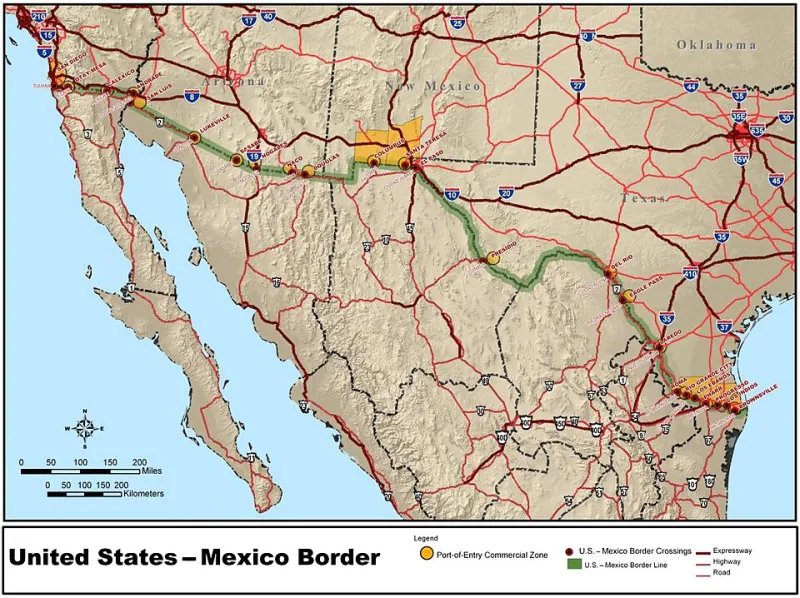
Photo: User Larsinio on en.wikipedia, Public domain, via Wikimedia Commons
For decades, the dominant logic of global manufacturing pointed east — to sprawling industrial zones in China, Vietnam, and Bangladesh. That logic is being systematically dismantled. A convergence of geopolitical friction, pandemic-era supply chain failures, and rising labor costs in Asia is prompting American manufacturers and retailers to look considerably closer to home. Mexico, already a cornerstone of North American commerce under the United States-Mexico-Canada Agreement (USMCA), is emerging as the preferred destination for reshored and nearshored production. The downstream effect on US maritime infrastructure is proving to be both profound and underappreciated.
The Nearshoring Imperative
The term "nearshoring" has circulated in logistics and procurement circles for years, but it carried relatively modest weight until roughly 2020. The COVID-19 pandemic exposed the fragility of extended, Asia-centric supply chains with startling clarity. Ports seized, container availability evaporated, and transit times ballooned from weeks to months. Then came escalating US-China trade tensions, new tariff regimes, and growing congressional scrutiny of dependency on foreign manufacturing for critical goods ranging from semiconductors to pharmaceuticals.
Mexico absorbed much of the resulting strategic pivot. Foreign direct investment in Mexican manufacturing surged to record levels in 2023, with the automotive, electronics, and aerospace sectors leading the charge. Industrial park vacancy rates in northern Mexican states — Nuevo León, Chihuahua, and Coahuila — dropped to historic lows as international firms rushed to establish or expand production capacity within striking distance of the US border.
The implications for maritime trade are significant. While cross-border truck and rail transport remain dominant modes for US-Mexico commerce, ocean freight is increasingly entering the equation — particularly for finished goods destined for US coastal markets and for raw material inputs arriving at Mexican Pacific ports before heading north.
Port Infrastructure Scrambles to Keep Pace
The Port of Laredo handles more US-Mexico trade volume than any other land crossing, but maritime gateways are registering the nearshoring effect in measurable ways. The Port of Houston, already one of the nation's busiest general cargo facilities, has seen a notable uptick in roll-on/roll-off (RoRo) and containerized traffic tied to Mexican automotive supply chains. Port officials there have accelerated terminal expansion planning, with particular attention to chassis availability and intermodal rail connections that can accommodate the surging volume of manufactured components moving between Texas and central Mexico.
Further west, the Port of Manzanillo on Mexico's Pacific coast — one of Latin America's highest-volume container terminals — has become a critical waypoint for Asian inputs destined for Mexican assembly operations. This creates a triangular flow that US West Coast ports are beginning to capture: goods arriving from Asia, cleared through Mexican manufacturing, and then re-exported northward as finished products. The ports of Long Beach and Los Angeles are actively courting logistics operators who can facilitate this kind of multi-leg movement.
On the Gulf Coast, the Port of Corpus Christi and the Port of Brownsville have both announced infrastructure modernization programs with an explicit eye toward capitalizing on nearshoring-driven growth. Brownsville's proximity to the Matamoros manufacturing corridor makes it particularly well-positioned to serve as a maritime complement to the heavy truck traffic that defines that border region.
USMCA as a Structural Accelerant
Trade policy is doing meaningful work here. USMCA, which replaced NAFTA in 2020, contains updated rules-of-origin requirements that incentivize North American content in manufactured goods — particularly in the automotive sector, where 75 percent of vehicle content must originate within the region to qualify for preferential tariff treatment. These provisions create a structural incentive to source components from within North America rather than importing them from Asia, reinforcing the manufacturing investment thesis for Mexico.
For port operators and logistics professionals, this matters because it shapes the nature of the cargo flows they can expect. USMCA-compliant supply chains tend to generate more predictable, contract-driven freight movements rather than the spot-market volatility that characterizes transpacific shipping. That predictability is attractive to terminal operators making long-horizon capital investment decisions.
Emerging Logistics Partnerships and Challenges
The commercial ecosystem forming around North American nearshoring is generating new categories of logistics partnership. Third-party logistics providers (3PLs) with deep cross-border expertise are in high demand, as are customs brokers capable of navigating the regulatory interface between Mexican manufacturing zones and US port entry. Several major US freight forwarders have expanded their Mexico City and Monterrey offices specifically to service this growing client segment.
Yet the opportunities come bundled with real operational challenges. US port infrastructure — much of it designed and built during an era when transpacific trade was the organizing principle of global commerce — is not uniformly equipped to handle the routing patterns that nearshoring generates. Chassis shortages, a persistent structural problem at US container ports, are particularly acute at Gulf Coast gateways. Drayage capacity in border regions remains constrained, and rail intermodal connections between northern Mexico and US interior markets require continued public and private investment.
Workforce development is another pressure point. The specialized skills required to manage complex cross-border logistics — bilingual documentation expertise, familiarity with both US Customs and Border Protection requirements and Mexican customs protocols — are in short supply relative to growing demand.
What Port Stakeholders Should Watch
For maritime professionals monitoring this space, several indicators merit close attention. Mexican manufacturing investment announcements — particularly in sectors with high component-intensity like electric vehicles and advanced electronics — are leading signals for future freight volume. US infrastructure spending allocations under the Bipartisan Infrastructure Law will shape which ports are best positioned to capture nearshoring-related growth over the medium term.
Geopolitical developments also bear watching. The US-China relationship remains a primary driver of corporate nearshoring decisions, and any material shift in that bilateral dynamic could alter the calculus for manufacturers currently weighing supply chain restructuring.
What is clear is that the geography of North American trade is being redrawn with meaningful speed. US maritime gateways that invest proactively in the infrastructure, workforce capacity, and commercial relationships required to serve Mexico-America trade corridors are positioning themselves at the center of what may prove to be a generational realignment in how goods move across this continent.