Water Levels, Rerouted Vessels, and the Ports Positioned to Profit From the Canal Crisis
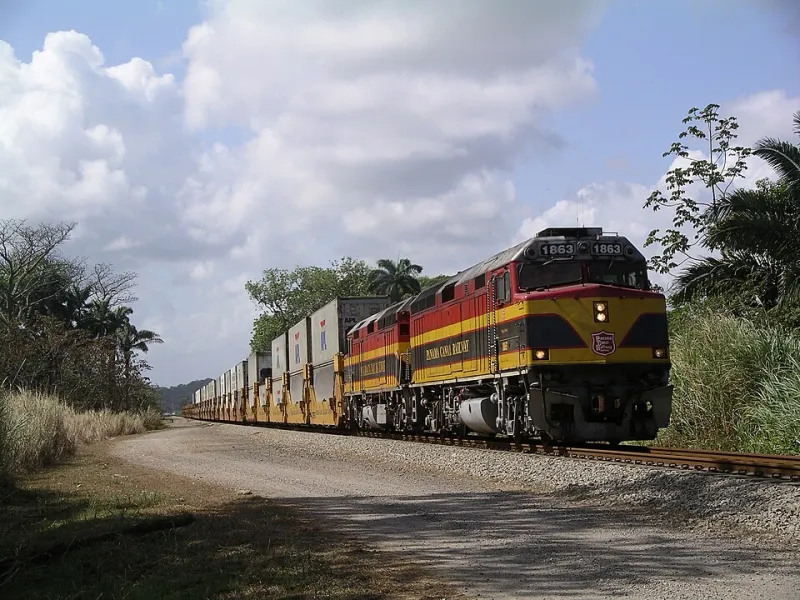
Photo: Nils Öberg, CC BY-SA 3.0, via Wikimedia Commons
For most of its century-long history, the Panama Canal has been treated as a fixed constant in global shipping equations — a reliable shortcut connecting the Atlantic and Pacific that US trade routes have been built around. That assumption is now under serious strain. Prolonged drought conditions linked to shifting climate patterns have driven water levels in Gatun Lake, the artificial reservoir that feeds the canal's lock system, to historic lows. The result has been a cascading series of operational restrictions that are quietly reordering the economics of transatlantic and transpacific freight.
The disruption is not theoretical. During the worst of the restrictions in late 2023 and into 2024, the Panama Canal Authority reduced daily transits and imposed draft limitations that effectively barred fully laden Neo-Panamax vessels from passage. Carriers faced a stark choice: lighten loads, pay premium fees for priority booking slots, or reroute entirely. Many chose the latter — and the ripple effects have reached every major US port from Savannah to Long Beach.
The Financial Weight of Going Around
The most immediate consequence of canal restrictions is the added cost of alternative routing. Vessels redirected around Cape Horn — the southern tip of South America — face voyages that can add anywhere from 14 to 21 days to an Asia-to-US-East-Coast transit, depending on origin and destination. That additional time translates directly into fuel consumption, crew costs, and delayed inventory cycles.
For a single voyage on a large container vessel, the incremental fuel cost alone can reach seven figures. Multiply that across a carrier's fleet operating multiple affected lanes, and the quarterly financial exposure becomes substantial. These costs do not evaporate at the carrier level — they migrate into surcharge structures, contract renegotiations, and ultimately, the landed cost calculations of US importers.
Freight forwarders operating on behalf of American retailers and manufacturers have reported meaningful increases in spot rate volatility on affected lanes. The unpredictability itself carries a cost, as procurement teams are forced to maintain larger inventory buffers to absorb potential delays — a reversal of the lean supply chain philosophy that dominated the previous decade.
Which US Ports Stand to Gain
Not every port faces the same exposure. The restrictions have accelerated a conversation that was already underway: the geographic diversification of US import gateways.
Gulf Coast ports, particularly the Port of Houston and the Port of New Orleans, have drawn renewed attention from carriers seeking alternatives that reduce dependence on Panama Canal transits for certain cargo flows. Vessels from South America and portions of Western Europe can reach Gulf ports without Canal access, and ongoing infrastructure investments at these facilities have improved their ability to handle increased volume.
East Coast ports in the Mid-Atlantic and Southeast — including the Port of Virginia and the Port of Savannah — have also benefited from rerouted traffic, though their advantage is somewhat more complex. For Asia-originating cargo that would normally transit the Canal, these ports remain dependent on alternative routing arrangements that add cost. However, for cargo originating in the Atlantic basin, they are well-positioned to absorb diverted volume.
On the West Coast, the calculus is different. Ports like Los Angeles, Long Beach, and Seattle-Tacoma handle the majority of transpacific container traffic and are not directly affected by Canal transit restrictions for that cargo. However, they have seen increased interest from shippers reconsidering East Coast delivery models — a trend that could gradually shift import gateway preferences if Canal reliability continues to decline.
Infrastructure Investment in an Uncertain Climate
The longer-term strategic question for US port authorities is whether the current disruption represents a temporary anomaly or a structural shift that justifies capital reallocation. That question does not have a clean answer, but the direction of investment suggests that many port operators are treating this as more than a passing weather event.
Several Gulf and East Coast ports have accelerated berth deepening and crane capacity expansion projects that were already in planning stages. The logic is straightforward: if Canal restrictions become a recurring feature of the global shipping environment rather than an isolated episode, ports that can handle larger vessels on alternative routing paths will capture durable market share.
The Port of Corpus Christi, for instance, has been expanding its bulk and liquid cargo handling capabilities in ways that position it favorably for energy-related trade flows that bypass the Canal entirely. Similarly, expanded rail connectivity at several Gulf ports strengthens their ability to serve inland distribution centers that have historically been supplied through West Coast gateways.
Private terminal operators are also paying attention. Investment decisions about crane procurement, yard equipment, and warehousing capacity are increasingly being stress-tested against scenarios where Panama Canal throughput remains constrained for extended periods.
Climate Risk as a Permanent Freight Variable
Perhaps the most significant long-term implication of the Canal drought is what it signals about climate risk as a freight planning variable. For decades, weather-related disruptions to major shipping infrastructure were treated as force majeure events — unpredictable, temporary, and outside the scope of routine logistics planning.
That framing is becoming difficult to sustain. Climate scientists have linked the El Niño patterns driving Gatun Lake's water deficit to broader atmospheric changes that are projected to intensify in frequency and severity. The Panama Canal Authority has invested in water conservation measures and is studying additional reservoir capacity, but hydrological constraints on the lock system are not easily engineered away.
For US shippers, this means that Panama Canal capacity should now be modeled as a variable rather than a constant. Routing diversification, once considered a contingency strategy for exceptional circumstances, is increasingly being treated as standard risk management practice. Carrier contracts that lock in routing flexibility, and service agreements that account for alternative transit times, are gaining traction in commercial negotiations.
The ports that will emerge strongest from this period of uncertainty are those that have invested in the infrastructure, connectivity, and operational capacity to serve as credible alternatives — not just when the Canal is restricted, but as a structural component of a more resilient US trade network. The drought has accelerated a strategic conversation that was always coming. The question now is which ports are ready to answer it.