The $50,000 Ripple: How a Single Day of Port Delay Unravels an Entire Delivery Chain
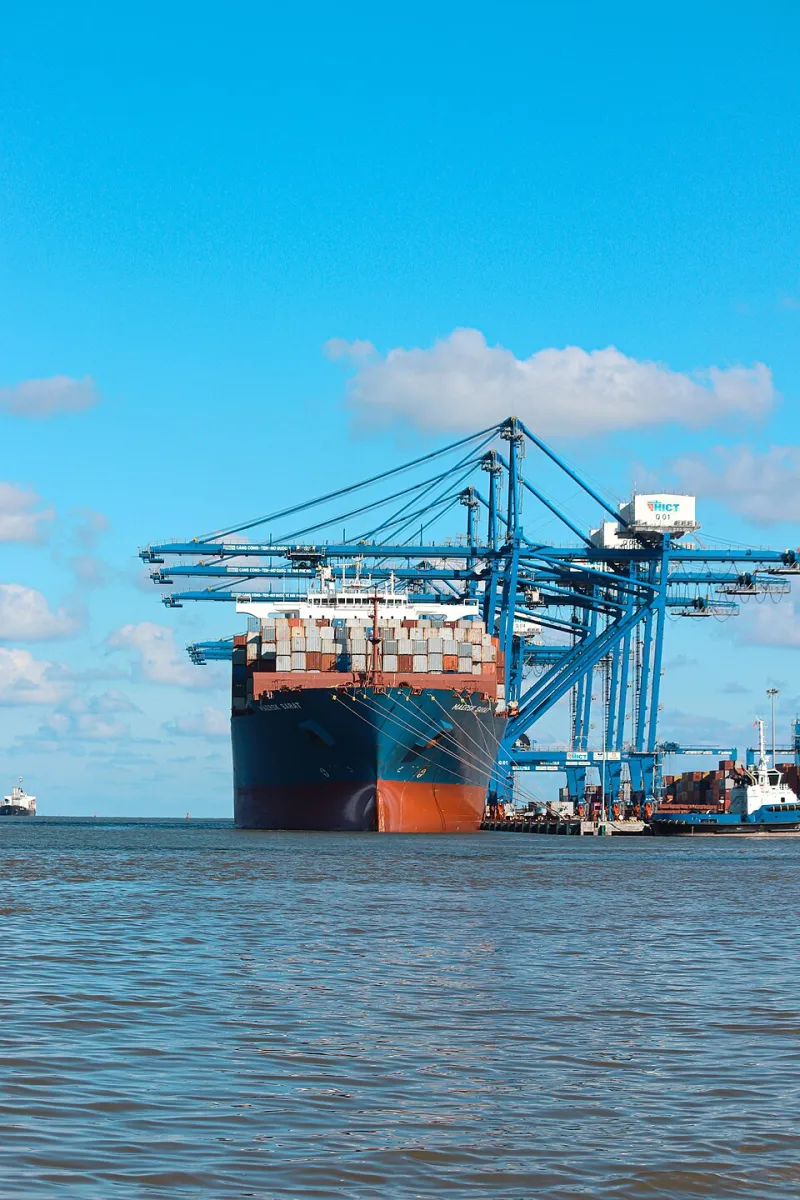
Photo: Nathan.cima, CC BY-SA 4.0, via Wikimedia Commons
For most maritime professionals, port dwell time is measured in hours and logged as an operational metric. But the financial consequences of that measurement extend far beyond the terminal gate—and far beyond what any single line item on a freight invoice will reveal. When a vessel sits idle for even one additional day at a major US port, it triggers a sequence of financial penalties, resource constraints, and missed commitments that compound rapidly as cargo moves—or fails to move—through the supply chain.
The true cost of a single day's delay, when traced through every downstream dependency, routinely exceeds $50,000 per vessel call. For mid-sized carriers managing thin margins in an already competitive market, that figure is not an abstraction. It is the difference between a profitable voyage and a loss.
Where the Clock Starts Running
The cascade begins the moment a vessel misses its scheduled berth window. At ports like the Port of Los Angeles, the Port of Savannah, or the Port of New York and New Jersey, berth allocation operates on tightly sequenced schedules. A vessel that arrives late—or one that cannot be processed on time due to labor constraints, equipment failure, or documentation backlogs—does not simply slot into the next available opening. It joins a queue, and that queue has its own costs.
Demurrage charges begin accruing once a container exceeds its allotted free time at the terminal, typically two to four days depending on the port and carrier agreement. A one-day delay in vessel processing compresses that free time window immediately. For a standard 40-foot container carrying general cargo, demurrage fees at major US ports currently range from $150 to $450 per day. Multiply that across even a modest vessel carrying 800 to 1,200 containers, and the daily exposure reaches six figures before a single box has left the terminal.
In documented cases reviewed by logistics analysts, a mid-sized container vessel delayed by 26 hours at a Gulf Coast port generated approximately $38,000 in demurrage obligations across its cargo manifest within the first 72 hours of that delay—before any additional disruptions materialized downstream.
The Chassis Shortage Multiplier
Demurrage is only the opening charge. As containers remain on terminal, the chassis pool serving that port tightens. Chassis availability in the US intermodal system has been a persistent vulnerability, particularly at inland distribution hubs connected to coastal ports via rail or truck. When terminal dwell extends beyond scheduled windows, chassis units committed to outbound moves remain locked under containers that cannot yet be picked up.
Trucking companies operating on day-rate chassis leases absorb those costs whether or not the equipment moves. At current lease rates of $35 to $55 per day per chassis unit, a fleet of 40 trucks waiting on delayed containers accumulates between $1,400 and $2,200 in daily chassis expense with zero productive output. Drivers idled during those windows represent additional labor cost, and in a market where qualified drayage operators are scarce, extended wait times risk driver attrition and schedule abandonment.
For carriers coordinating time-sensitive intermodal transfers, the chassis bottleneck at the port propagates directly into rail yard scheduling conflicts. A missed cut-off at an inland rail ramp—often triggered by a two- to four-hour margin—means cargo waits an additional 24 hours for the next available train. That single missed connection can add $800 to $1,500 in repositioning and re-booking costs per container.
Warehouse Overflow and the Storage Premium
As delayed cargo eventually clears the terminal and moves inland, it does not arrive into a system that has been waiting patiently. Warehouse receiving appointments are scheduled weeks in advance at major distribution centers. A one-day delay in vessel processing typically translates to a 48- to 72-hour delay in cargo availability, by the time terminal processing, drayage scheduling, and inland transit are accounted for.
Fulfillment centers and third-party logistics providers operating at or near capacity—a common condition at facilities serving major retail corridors in Southern California, the Chicago metro area, and the Southeast—cannot simply absorb late arrivals. Overflow storage rates at bonded or third-party facilities range from $0.35 to $0.75 per square foot per month, but short-term overflow premiums during peak periods can reach $1.50 per square foot or higher. For a shipment occupying 2,000 square feet of warehouse space for an unplanned two-week overflow period, that premium represents an unbudgeted cost of $2,100 to $4,200 on a single consignment.
When that cargo is perishable, temperature-controlled, or time-sensitive consumer goods, the stakes escalate further. Retailers operating on just-in-time replenishment models impose penalties for late delivery that are contractual, not discretionary. Chargeback rates from major US big-box retailers for missed delivery windows range from 1% to 3% of invoice value—on a $500,000 shipment, that is a $5,000 to $15,000 penalty absorbed by the shipper or carrier, depending on contract terms.
The Downstream Customer Relationship Cost
Beyond the quantifiable charges lies a category of cost that is harder to invoice but no less real: the erosion of customer confidence. US importers and exporters operating in competitive product categories—consumer electronics, automotive components, retail apparel—have increasingly built carrier selection criteria around reliability metrics rather than rate minimization alone. A carrier that consistently generates delay-related chargebacks, missed appointment fees, or expedite surcharges will face contract renegotiation cycles that compress margins over time.
One logistics manager at a Southeast-based automotive parts importer described the internal accounting process bluntly in an industry forum: "We stopped looking at freight rates in isolation two years ago. We now track total landed cost per shipment, and dwell-related charges account for 18% of our variance against budget. That number drives our carrier review process."
This shift in procurement behavior has measurable consequences for carriers. Losing a mid-sized importer contract worth $2 million to $5 million annually over accumulated service failures—each traceable to dwell time events—represents a cost that no single incident report will ever capture.
Reducing Dwell Time as a Financial Strategy
The operational interventions most effective at reducing port dwell time are well-established: pre-arrival documentation submission, participation in port community system platforms, strategic use of off-dock container yards, and investment in real-time terminal visibility tools. What has changed is the financial calculus motivating their adoption.
Carriers and logistics providers that have modeled the full downstream cost of delay—not merely the demurrage line item—are increasingly treating dwell time reduction as a revenue protection strategy rather than a service quality initiative. The distinction matters because it shifts investment decisions. Spending $15,000 annually on a terminal visibility subscription becomes straightforward when the platform demonstrably prevents two or three delay events per year that would otherwise generate $50,000 or more in aggregate exposure.
The arithmetic of port delay has always been unfavorable. What is becoming clearer, as carriers develop more sophisticated cost-tracking capabilities, is just how unfavorable it truly is—and how far the damage travels before it finally stops.