Rivers Reconsidered: How Inland Waterway Barge Transport Is Reclaiming Ground From the Highway
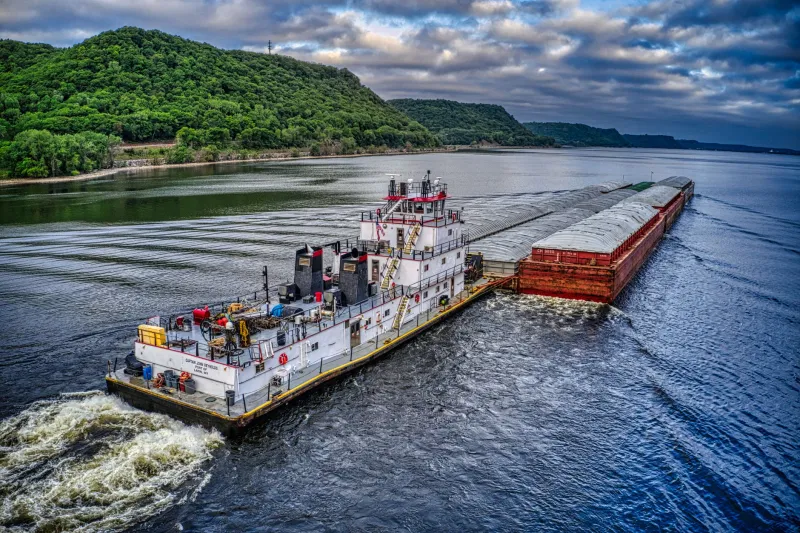
For much of the past two decades, America's inland waterway system occupied a peculiar place in the logistics landscape — acknowledged as a national asset, yet routinely overlooked in favor of trucking's flexibility and speed. That calculus is beginning to shift. Driven by a combination of structural pressures on the highway freight market and a renewed focus on cost efficiency, shippers moving bulk commodities across regional trade lanes are giving inland barge transport a second look — and in many cases, finding the economics surprisingly compelling.
The shift is not happening in isolation. It reflects a broader recalibration within US supply chain strategy, where resilience and cost predictability have risen sharply in priority following years of disruption. For logistics operators positioned along key waterway corridors, the opportunity is real — though so are the constraints that must be managed carefully.
The Highway Problem That Won't Go Away
The trucking industry's structural challenges are by now well-documented, but their cumulative effect on shipper costs continues to compound. Driver shortages remain persistent across the continental United States, with the American Trucking Associations estimating a deficit that has hovered near or above 60,000 drivers for several years running. Recruitment and retention difficulties have kept capacity tight even as demand fluctuates, contributing to rate volatility that makes long-range freight budgeting difficult.
Fuel price swings have added another layer of unpredictability. Diesel prices in the US have experienced pronounced volatility since 2021, and while spot rates have moderated in some periods, the underlying exposure remains. Trucking's fuel intensity — a fully loaded Class 8 truck averaging roughly six miles per gallon — means that price spikes translate quickly and directly into carrier surcharges.
Overlaid on these pressures is the condition of America's road infrastructure itself. The American Society of Civil Engineers has consistently graded US roads with below-average marks, and weight restrictions on deteriorating bridges in agricultural and industrial corridors have begun to affect route planning for heavy freight. In parts of the Midwest and Southeast, these restrictions are not theoretical — they are rerouting trucks and adding miles to hauls that were already marginal.
Why Barge Economics Look Different Now
Against this backdrop, the fundamental efficiency of barge transport has become newly relevant. A single 15-barge tow on the Mississippi River system can carry the equivalent payload of roughly 1,050 semi-trucks or 216 railcars. That tonnage-per-fuel-unit advantage translates into a cost-per-ton-mile figure that, for the right commodity and the right corridor, is difficult to match by road.
The commodities most suited to inland waterway movement — grain, fertilizer, coal, petroleum products, steel, and certain aggregates — remain central to US industrial and agricultural output. For shippers moving these materials in volume along corridors served by navigable waterways, the barge option has always existed in theory. What has changed is the margin between barge and truck economics, which has widened sufficiently to prompt serious operational reconsideration.
Fuel consumption comparisons are particularly stark. Barge transport is estimated to move one ton of cargo approximately 616 miles per gallon of fuel, compared to roughly 155 miles per gallon for trucking. As diesel prices remain elevated relative to pre-2020 baselines, this differential increasingly shows up in landed cost calculations.
Key Corridors and Their Current Dynamics
The Mississippi River system remains the backbone of US inland waterway commerce, stretching from Minnesota to the Gulf of Mexico and connecting to tributaries including the Ohio, Missouri, Illinois, and Tennessee rivers. This network serves the agricultural heartland and the industrial Midwest, carrying grain exports from interior elevations to Gulf export terminals at New Orleans and the surrounding complex.
The Ohio River corridor, connecting Pittsburgh to Cairo, Illinois, carries significant volumes of coal, steel inputs, and petrochemicals. Industrial operators in states including Kentucky, Ohio, West Virginia, and Indiana have historically relied on this corridor for heavy materials movement, and several are revisiting barge options as road freight costs have risen.
The Hudson River and New York Bight region presents a different but increasingly relevant picture. While not a bulk commodity corridor in the same sense, the Hudson supports barge movements of construction materials, aggregates, and petroleum products serving the New York metropolitan area — one of the most congested trucking environments in the country. For builders and distributors supplying large infrastructure projects in and around New York City, river-based delivery options are attracting renewed commercial interest, particularly as urban congestion pricing policies add new costs to truck-based last-mile logistics.
Capacity Constraints Demand Honest Assessment
Any analysis of the inland waterway opportunity that omits the sector's infrastructure challenges would be incomplete. The lock-and-dam system that makes much of the Mississippi and Ohio river navigation possible is aging. The US Army Corps of Engineers manages hundreds of locks across the inland system, and a significant portion of this infrastructure is operating beyond its intended service life. Lock failures and unplanned closures have caused costly delays for barge operators in recent years, and the unpredictability of these events complicates service reliability commitments to shippers accustomed to truck transit guarantees.
Water level variability presents a related challenge. Drought conditions along the Mississippi in 2022 reduced draft allowances significantly, forcing barge operators to reduce loads and, in some cases, suspend service on certain reaches. Climate-driven hydrological variability is not a new concern, but its frequency and severity have increased, introducing a seasonal reliability risk that logistics planners must account for.
Barge terminal infrastructure at origin and destination points also requires investment. Not every industrial facility has direct waterway access, and the cost of transloading — moving cargo from truck or rail to barge and back — can erode cost advantages on shorter movements. Operators considering modal shifts to waterway transport must conduct honest assessments of their supply chain topology before committing.
Repositioning Barge as a Strategic Complement
The most effective operators are not positioning inland waterway transport as a wholesale replacement for trucking. Rather, they are integrating barge capacity as a deliberate complement within multimodal networks — using waterway movement for the long-haul, high-volume portions of regional lanes while retaining truck capacity for terminal distribution and time-sensitive segments.
This positioning also carries a sustainability dimension that is increasingly relevant to corporate procurement decisions. Barge transport produces significantly lower greenhouse gas emissions per ton-mile than road freight, a characteristic that aligns with Scope 3 emissions reduction commitments many US shippers have made publicly. For logistics operators capable of quantifying and communicating this advantage, the environmental narrative is becoming a genuine commercial differentiator — particularly among agricultural exporters and industrial manufacturers with sustainability reporting obligations.
Several regional carriers and terminal operators along the Mississippi and Ohio systems have begun marketing barge services explicitly on this basis, pairing cost-per-ton-mile comparisons with emissions intensity data in proposals to potential shipper clients.
The Outlook for Inland Waterway Commerce
The renewed competitiveness of inland waterway barge transport is not a temporary phenomenon driven solely by short-term trucking market conditions. The structural drivers — driver workforce demographics, road infrastructure investment gaps, fuel cost exposure, and emissions accountability — are durable. They will not resolve quickly, and their persistence creates a sustained window of commercial opportunity for waterway operators willing to invest in reliability, terminal capacity, and shipper education.
For US shippers managing commodity supply chains along corridors where waterway access exists, the conversation has moved from theoretical consideration to active operational planning. The rivers have not changed. What has changed is the economic environment surrounding them — and for the first time in years, that environment is pointing downstream.